
NTPC, Maruti, SBI, PowerGrid, Bajaj Auto, UltraTech Cement and Axis Bank rose up to 2.95 per cent.

Retail sales of passenger vehicles grew last month but the sales of two-wheeler and commercial vehicles remained low compared to the pre-COVID month of May 2019, according to automobile dealers' body FADA. On Monday, FADA said that overall auto retails stood at 16,46,773 units in May, down from 18,22,900 units in May 2019. "May 2022 retails when compared to May 2019 reveal that sales are still not on a growth trajectory as overall retails were down by 10 per cent.

The country's largest carmaker Maruti Suzuki India (MSI) on Thursday reported 2.04 per cent increase in its consolidated net profit for the second quarter at Rs 1,419.6 crore on the back of higher sales. The auto major had posted a net profit of Rs 1,391.1 crore in the July-September quarter of the previous fiscal.

'We are seeing signs of improvement in rural overall in terms of demand, but I would still keep my fingers crossed.'

The government is likely to extend fiscal incentives for production of toys, bicycles and leather and footwear in the forthcoming budget as it looks to expand production linked incentive (PLI) scheme to cover more high-employment potential sectors, sources said. The government has already rolled out the scheme with an outlay of about Rs 2 lakh crore for as many as 14 sectors, including automobiles and auto components, white goods, pharma, textiles, food products, high efficiency solar PV modules, advance chemistry cell and speciality steel. The scheme aims to make domestic manufacturing globally competitive and create global champions in manufacturing, and it is yielding solid results, sources said.
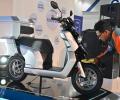
India's electric two-wheeler (E2W) sector is expected to cross the one million mark in 2024 fuelled by rising demand, increased production, and affordability, industry experts said, even as several original equipment makers are expanding their penetration to rural areas. Improved battery technology and innovative features are also likely to fuel growth, they said. "E2W sales will breach the 1-million mark in 2024 as the demand for electric two-wheelers is expected to continue growing due to factors such as environmental awareness, government incentives, and improvements in technology," Hyder Khan, chief executive officer (CEO), Godawari Electric Motors, said.
From steel tycoon Lakshmi Mittal to billionaire Sunil Bharti Mittal's Airtel, Anil Agarwal's Vedanta, ITC, Mahindra and Mahindra, and a lesser-known Future Gaming and Hotel Services were among the prominent buyers of the now-scrapped electoral bonds for making political donations.

The BSA Gold Star is launched....Ola Enters e-motorbikes Biz... Bajaj, TVS To Enter e2Ws Market...
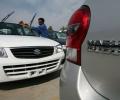
The country's largest carmaker Maruti Suzuki India (MSI) aims to sell 4-6 lakh CNG units in the current fiscal year depending upon supply situation of essential components, as per a senior company official. The company sold about 2.3 lakh CNG units in 2021-22. MSI currently sells nine of its 15 models with CNG powertrain and is looking to drive in more models with such technology in the coming days.
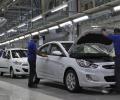
The country's leading automakers Maruti Suzuki and Hyundai Motor reported a decline in dispatches to dealers in March as shortage of electronic components impacted production. On the other hand, Tata Motors, Skoda and Kia India posted their highest ever monthly wholesales last month. Toyota Kirloskar Motor said its dispatches in March were the highest in the last five years while Mahindra & Mahindra also reported a robust increase in its passenger vehicle dispatches in March.

Senior Tesla executives including those from its supply chain are planning to come to India on Wednesday and Thursday for meetings with government officials, including those in the Prime Minister's Office, according to sources. Prashant R Menon, director of Tesla India, did not respond to a specific query on the meetings. Sources say that the executives are coming to see how they can expand and develop local sourcing of components from India for the Tesla car.

OSAT majors have concerns about India's ability to provide a stable, predictable, and lasting policy environment for years to come, which is key for making a decision in a capital-intensive business.

Input shortages and low inventories, according to Nomura, will likely lead to production cuts and delayed shipments in the September 2021 quarter.

SoftBank Group-backed Ola Electric is in talks with multiple global suppliers to build a battery cell manufacturing plant in India with a capacity of up to 50-gigawatt hours, sources said. As part of its broader electrification push, the firm plans to invest in companies with advanced cell and battery technology, alongside the 50 Gwh battery plant. Ola Electric needs 40 Gwh of battery capacity to power 10 million electric scooters annually. The remainder will be for its electric cars, which the company plans to manufacture in the future.

M&M also saw its domestic passenger vehicle sales grow by 1 per cent, while Toyota Kirloskar Motor witnessed a decline in its PV sales.

India's largest car maker, Maruti Suzuki, has put in place a new strategy to reduce its dependence on Japan for auto parts.

The Reserve Bank of India (RBI) on Wednesday announced to increase the policy repo rate by 50 basis points to 4.9 per cent, the second hike in five weeks aimed at quelling the inflation. The MPC vote was unanimous and has decided to keep stance withdrawal from accommodative, RBI Governor Shaktikanta Das said in a press conference on Wednesday. The decision was taken during a three-day meeting of the RBI's Monetary Policy Committee (MPC) to review the interest rates in the country. The MPC voted unanimously to increase the policy repo rate by 50 bps to 4.90 per cent," Das said.

Tata Motors is looking at various measures, including direct buying from stockists and making changes in the product configurations, to offset the impact of semiconductor shortage on its production activities and sales, a top company official has said. The auto major, which sells models including Nexon, Harrier and Safari in the domestic market, is also looking at different kinds of chips which could be used in components where the supply situation is severe. The automaker expects the situation to remain challenging in the ongoing quarter and some improvement in supplies only in the second half of the fiscal.

GST will yield 'better value for money' for car buyers, increasing automobile industry demand, says Sandip Neogi.

Close to 50 models were launched in India in the past 12 months, but companies have not been able to realise their potential due to the pandemic.
Foundries in Taiwan account for more than 75 per cent of the chips that mobile devices made in India need, according to estimates by the Indian Cellular and Electronics Association (ICEA), which represents global and domestic manufacturers. The number is slightly lower, 60 per cent, if one considers all chips -- those of consumer electronics, PCs, laptops, autos, etc. This ties in with the fact that foundries in Taiwan, led by TSMC, account for over 70 per cent of the world's microchip supply, according to estimates by Gartner.
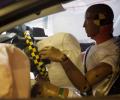
The government has deferred the implementation of the proposal to make six airbags mandatory in passenger cars by one year to October 1, 2023, Road Transport and Highways Minister Nitin Gadkari said on Thursday. The government had earlier planned to make six airbags mandatory in eight-seater vehicles for enhanced safety of occupants from October 1, 2022. "Considering the global supply chain constraints being faced by the auto industry and its impact on the macroeconomic scenario, it has been decided to implement the proposal mandating a minimum of 6 Airbags in Passenger Cars (M-1 Category) w.e.f 01st October 2023," Gadkari said in a tweet.

Within three trading sessions in May, foreign portfolio investors (FPIs) have pumped in Rs 9,461 crore into Indian equities. This follows net inflows worth Rs 7,936 crore in March, and Rs 11,631 crore in April. The trend, analysts said, could continue going ahead as the US Federal Reserve may soon halt its interest rate hike cycle, which will strengthen foreign fund inflows into emerging markets, including India.

From powering mobile devices, US chip designer Qualcomm has tied up with Ola Electric to power its electric scooters. Qualcomm is providing the key 4G connected octa core android platform which provides connectivity, computing capabilities and enables rich immersive displays with power saving software.

The Jats, who went on a rampage to demand quota, attacked the showrooms of only non-Jats.

A large number of American companies like Google, Uber and IBM are offering their resources to help India successfully fight the battle against the deadly coronavirus pandemic.
Electric scooter registrations of eight companies which represent 95 per cent of the market have seen a sharp fall of over 24 per cent in May. They have registered 32,680 electric scooters against 43,098 in April according to VAHAN data from the Ministry of Road Transport and Highways available till the evening of 31 May. Auto analysts say the fall is a reflection of the initial pent up demand in the market for such vehicles,which was evinced in huge bookings, being met.

It reverses the supply chain to customise part of its line-up, but the challenge is in sustaining it.

Infosys was the top gainer in the Sensex pack, jumping over 4 per cent, followed by Tech Mahindra, Tata Steel, ICICI Bank, ITC, Maruti, SBI and Axis Bank. On the other hand, HCL Tech, M&M, Dr Reddy's, Asian Paints, Bajaj Auto and Bharti Airtel were among the laggards.


Leading tyre maker Apollo also saw a production loss of 450 tonnes till December 2.

With a new chief executive officer (CEO) at the helm, the country's largest two-wheeler maker Hero MotoCorp is now looking to cut flab and move towards a leaner organisation. It has launched a voluntary retirement scheme (VRS) for its staff as it aims to make the organisation 'agile and future-ready'. Recently, the company's erstwhile chief financial officer (CFO) Niranjan Gupta was elevated as CEO.

Indian auto industry's dependence on China is high and it will continue to be so in the BS-VI era and as the country moves towards electric mobility. Domestic players lack both technological competence and the sheer pricing advantage that support Chinese imports.

Novelis' results for the January-March quarter of the 2022-23 financial year (Q4FY23) disappointed investors and as a result, the share price of Hindalco (Novelis is a 100 per cent subsidiary of Hindalco) has slid. The non-ferrous metals major is suffering from the impact of a down-cycle in aluminium and copper, as well as the slowdown imposed in Europe by the Russia-Ukraine war. Prospects for the firm look gloomy, at least for the first half (H1) of FY24.

Passenger vehicle wholesales in India witnessed a decline of 41 per cent year-on year in September as automobile manufacturers struggled to produce adequate units owing to semiconductor shortage, auto industry body SIAM said on Thursday. Passenger vehicle sales last month stood at 1,60,070 units as compared with 2,72,027 units in the year-ago period. As per the latest data by Society of Indian Automobile Manufacturers (SIAM), two-wheeler dispatches to dealers also witnessed a dip of 17 per cent at 15,28,472 units, compared to 18,49,546 in September 2020.

German premium car maker Mercedes-Benz on Wednesday reported nearly 100 per cent growth in sales at 4,101 units in the domestic market in September of the current year. Mercedes-Benz India had sold 2,058 cars in the Indian market in the July-September period of 2020. The strong rebound in sales particularly in Q3 2021 retail, reflects the continuous V-shaped recovery witnessed since the pandemic affected second quarter (April-June), owing to the return of economic activities, a stable economy at large and an overall positive market outlook.

For Mahindra & Mahindra (M&M), which has just started executing a comeback strategy for wresting back ground it lost to rivals, this could not have come at a worse time. The maker of the Bolero Neo and the Thar models on Thursday said it would have to halt production at its automotive plant for a week due to the worsening supply situation of semiconductors.

Logistics, due to road conditions, continues to pose a challenge.

Passenger vehicle wholesales in India rose significantly year-on-year in July, as COVID-led restrictions eased across states and companies pushed stocks to dealers to build up inventories for the upcoming festive season, SIAM said on Thursday. The total passenger vehicle sales -- including dispatches of cars, utility vehicles and vans -- from OEMs to dealerships increased by 45 per cent to 264,442 units in July against 182,779 units in the same month last year. According to the latest data by the Society of Indian Automobile Manufacturers (SIAM), two-wheeler dispatches from the OEMs to dealerships, however, declined by 2 per cent to 12,53,937 units in July, compared to 12,81,354 units in the year-ago period.

